
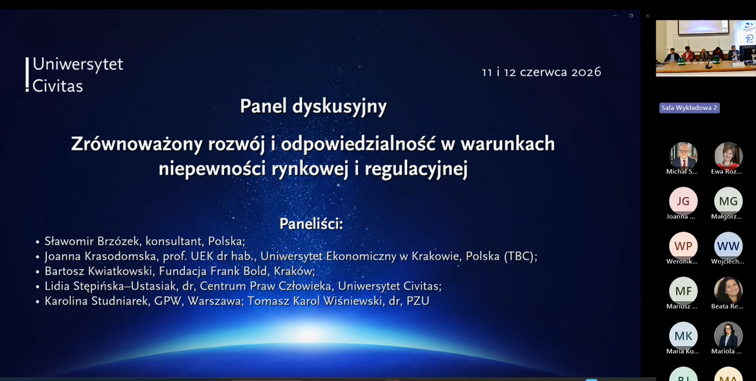
Zrównoważony rozwój i odpowiedzialność w warunkach niepewności rynkowej i regulacyjnej
Sustainability and Responsibility under Conditions of Market and Regulatory Uncertainty
Relacja z debaty okrągłego stołu (round table debate)
2026 Civitas University Social Horizons Forum / Forum Horyzontów Społecznych Uniwersytetu Civitas
Pałac Kultury i Nauki w Warszawie, 12 czerwca 2026 r. (panel C15, panele równoległe IV)
Podczas Forum Horyzontów Społecznych Uniwersytetu Civitas odbyła się debata poświęcona zrównoważonemu rozwojowi i odpowiedzialności w warunkach niepewności rynkowej i regulacyjnej. Poprowadzono ją w formule round table debate – jako rozmowę, w której uczestnicy reagowali na wzajemne tezy, a nie serię niezależnych wystąpień.
Spotkanie moderowała dr Magdalena Zajączkowska z Uniwersytetu Ekonomicznego w Krakowie. Debata była współorganizowana przez Centrum Praw Człowieka Uniwersytetu Civitas oraz objęta patronatem przez Fundację GPW i Krakowską Szkołę Biznesu UEK.
Przy stole zasiadło sześcioro panelistów reprezentujących celowo różne punkty widzenia: prof. UEK dr hab. Joanna Krasodomska (Uniwersytet Ekonomiczny w Krakowie) wniosła perspektywę akademicką i ekspertyzę w zakresie standaryzacji raportowania oraz atestacji; Karolina Studniarek (Giełda Papierów Wartościowych w Warszawie) – głos infrastruktury rynku kapitałowego; Bartosz Kwiatkowski (Fundacja Frank Bold) – perspektywę prawniczo-adwokacką; dr Lidia Stępińska-Ustasiak(Centrum Praw Człowieka, Uniwersytet Civitas) – spojrzenie socjologiczne i perspektywę praw człowieka w łańcuchu wartości; Sławomir Brzózek – doświadczenie praktyka wdrażającego ESG w firmach i reprezentanta branży opakowaniowej; dr Tomasz Karol Wiśniewski (SIF Poland) – perspektywę inwestora instytucjonalnego i jednego z pionierów ESG na polskim rynku kapitałowym, twórcy RESPECT Index i WIG-ESG.
Punktem wyjścia była diagnoza wyjątkowo niestabilnego momentu. Wiosną 2026 roku w Unii Europejskiej obowiązuje pakiet Omnibus, upraszczający i zawężający obowiązki wynikające z CSRD i CSDDD, wciąż wdrażany przez państwa członkowskie. Trwa rewizja ESRS, a wytyczne do CSDDD spodziewane są dopiero w 2027 roku. Równolegle za oceanem amerykański regulator rozpoczął odwrót od obowiązkowych ujawnień klimatycznych, a w tle toczy się rywalizacja o to, czy globalnym językiem raportowania pozostanie europejskie ESRS, czy konsolidujące się wokół siebie ISSB. Debata miała odpowiedzieć na pytanie, czy w takiej niepewności da się sensownie zarządzać firmą i poważnie traktować zobowiązania transformacyjne.
Europa i krajobraz standardów
Pierwsza część rozmowy dotyczyła pozycji Europy. Padło pytanie, czy pozostaje ona liderem raportowania zrównoważonego rozwoju, czy raczej traci wpływ na kształt standardów globalnych. Z dyskusji wyłoniło się rozróżnienie między ambicją regulacyjną a rzeczywistą zdolnością „eksportu” własnego modelu – sama surowość wymogów nie przesądza jeszcze o przywództwie. Z perspektywy rynku i odbiorców danych ESG kluczowe okazały się porównywalność, użyteczność i koszt informacji, a nie poziom ambicji standardu. Pojawiła się też propozycja, by o europejskim przywództwie myśleć nie jako o utrzymywaniu najbardziej wyśrubowanych wymogów, lecz jako o zdolności zapewnienia interoperacyjności i praktycznej przydatności danych.
Omnibus: uproszczenie i przesunięcie ciężaru
Najgorętsza część debaty dotyczyła pakietu Omnibus, trzy miesiące po jego wejściu w życie. Osią sporu było pytanie, czy uproszczenie regulacji rzeczywiście zmniejsza obciążenia firm, czy jedynie przenosi je w inne obszary – ryzyko reputacyjne, sądowe i ryzyko łańcucha wartości. Wskazywano, że choć z bezpośredniego zakresu CSDDD wypadła większość przedsiębiorstw, obowiązki klimatyczne pozostały, a usunięcie zharmonizowanego unijnego reżimu odpowiedzialności cywilnej przesunęło niepewność prawną na poziom krajowy – do wielu odrębnych porządków sądowych. Z perspektywy praw człowieka wybrzmiała obawa o utratę momentu, w którym budowała się kultura należytej staranności, oraz pytanie, czy duże firmy będą wymagać standardów due diligence od dostawców również bez ustawowego przymusu.
Głos praktyki dorzucił do tego istotny wątek: uproszczenie regulacji horyzontalnych nie oznacza mniejszej liczby obowiązków, skoro regulacje sektorowe – opakowania, baterie, deforestacja czy taksonomia – postępują dalej. W sumie przedsiębiorstwo niewiele oszczędza, a zmiana reguł w trakcie gry sama w sobie jest kosztem. W szybkiej rundzie o to, czy bardziej opłaca się być liderem zmian, czy czekać na ich ostateczny kształt, przeważyło przekonanie, że bierne oczekiwanie na stabilizację prawa może być najdroższą ze strategii.
Edukacja, badania i reguły gry
Ostatnia część przesunęła punkt ciężkości na warunki długookresowego trwania. W wątku edukacyjnym zgodzono się, że w trzyletnim cyklu kształcenia nie sposób nadążyć za regulacjami zmieniającymi się co rok – dlatego uczyć trzeba raczej kompetencji analitycznych niż szczegółu przepisu, a samą edukację ESG wzbogacić o interdyscyplinarność, w tym perspektywę socjologiczną i praw człowieka. W wątku badawczym wskazano na lukę po stronie regulatora, który często decyzje podejmuje bez wystarczającego zaplecza analitycznego, oraz na niedostatek rzetelnych, polskich badań łączących decyzje inwestycyjne z czynnikami zrównoważonego rozwoju. Syntetyczna runda wokół pytania, czy możliwa jest efektywna transformacja gospodarcza bez stabilnych i wiarygodnych reguł gry, przyniosła spójne ostrzeżenie: bez przewidywalności prawa odpływają i kapitał, i ambicja, a same reguły są warunkiem, lecz nie gwarancją zmiany.
Konkluzja
Najcenniejszym efektem debaty nie było rozstrzygnięcie sporu, lecz jego precyzyjne nazwanie. Rzecz nie w tym, czy być „za regulacją, czy przeciw”, ale w tym, dokąd przesuwa się ciężar, gdy prawo się upraszcza: do firm, do sądów krajowych, do dostawców, czy do inwestorów. W warunkach niepewności – europejskiego odwrotu od części obowiązków, amerykańskiego odwrotu od ujawnień i globalnej konsolidacji wokół ISSB – uczestnicy byli zgodni co do jednego: przewidywalność reguł gry jest dobrem rzadkim, a jej brak ma realną cenę, którą ktoś zawsze zapłaci.
Panel odbył się w ramach 2026 Civitas University Social Horizons Forum (Forum Horyzontów Społecznych Uniwersytetu Civitas), 11–12 czerwca 2026 r., Pałac Kultury i Nauki w Warszawie oraz online.
Debata odbyła się dzięki wsparciu finansowemu Unii Europejskiej w ramach projektu Polityka klimatyczno-energetyczna Unii Europejskiej w zrównoważonej transformacji (EU Climate and Energy Policy in Sustainable Transition; CLEaR; Jean Monnet Module). Project number: 101176608 – CLEaR – ERASMUS-JMO-2024-HEI-TCH-RSCH
Sfinansowano ze środków Unii Europejskiej. Wyrażone poglądy i opinie są jedynie opiniami autora lub autorów i niekoniecznie odzwierciedlają poglądy i opinie Unii Europejskiej lub Europejskiej Agencji Wykonawczej ds. Edukacji i Kultury (EACEA). Unia Europejska ani EACEA nie ponoszą za nie odpowiedzialności.
EN:
At the Civitas University Social Horizons Forum, a debate was held on sustainability and responsibility under conditions of market and regulatory uncertainty. It was conducted in a round table format — as a conversation in which the participants responded to one another’s arguments rather than delivering a series of independent presentations.
The session was moderated by Magdalena Zajączkowska, PhD, of the Kraków University of Economics. The debate was co-organised by the Human Rights Centre of Civitas University and held under the patronage of the GPW Foundation and the Cracow School of Business at the Kraków University of Economics.
Six panellists took their seats at the table, deliberately representing different points of view: Professor Joanna Krasodomska(Kraków University of Economics) brought an academic perspective and expertise in the standardisation and assurance of reporting; Karolina Studniarek (Warsaw Stock Exchange) offered the voice of capital-market infrastructure; Bartosz Kwiatkowski (Frank Bold Foundation) provided a legal and advocacy perspective; Lidia Stępińska-Ustasiak, PhD (Human Rights Centre, Civitas University) contributed a sociological view and the perspective of human rights in the value chain; Sławomir Brzózek shared the experience of a practitioner implementing ESG in companies and a representative of the packaging industry; and Tomasz Karol Wiśniewski, PhD (SIF Poland) brought the perspective of an institutional investor and one of the pioneers of ESG on the Polish capital market, the creator of the RESPECT Index and WIG-ESG.
The starting point was a diagnosis of an exceptionally unstable moment. In the spring of 2026, the European Union’s Omnibus package — simplifying and narrowing the obligations arising from the CSRD and the CSDDD — is in force and still being implemented by the Member States. The revision of the ESRS is under way, and guidance on the CSDDD is not expected until 2027. At the same time, across the Atlantic, the US regulator has begun to retreat from mandatory climate disclosures, while in the background a contest continues over whether the global language of reporting will remain the European ESRS or the ISSB now consolidating the field around itself. The debate set out to answer whether, amid such uncertainty, a company can still be managed sensibly and transformational commitments taken seriously.
Europe and the standards landscape
The first part of the conversation concerned Europe’s position. The question was raised whether Europe remains a leader in sustainability reporting or is beginning to lose its influence over the shape of global standards. A distinction emerged between regulatory ambition and the actual capacity to “export” one’s own model — the mere stringency of requirements does not, in itself, determine leadership. From the perspective of the market and of the users of ESG data, what proved decisive was the comparability, usefulness and cost of information, rather than the level of a standard’s ambition. A proposal was also put forward to conceive of European leadership not as maintaining the most exacting requirements, but as the ability to ensure the interoperability and practical usefulness of data.
Omnibus: simplification and the shifting of the burden
The most heated part of the debate concerned the Omnibus package, three months after its entry into force. The crux of the dispute was whether the simplification of regulation genuinely reduces the burden on companies or merely shifts it to other areas — reputational risk, litigation risk and value-chain risk. It was observed that, although most enterprises have fallen outside the direct scope of the CSDDD, climate obligations have remained, and the removal of the harmonised EU civil-liability regime has shifted legal uncertainty to the national level — to numerous separate judicial systems. From the human-rights perspective, concern was voiced about the loss of a moment in which a culture of due diligence had been taking shape, together with the question of whether large companies will require due-diligence standards of their suppliers even in the absence of a statutory obligation.
The practitioner’s voice added an important thread: simplifying horizontal regulation does not translate into fewer obligations, since sectoral regulations — packaging, batteries, deforestation and the taxonomy — continue to advance. On balance, an enterprise saves little, and changing the rules mid-game is itself a cost. In a rapid round on whether it is more advantageous to be a leader of change or to wait for its final shape, the prevailing conviction was that passively waiting for the law to stabilise may prove the most expensive strategy of all.
Education, research and the rules of the game
The final part shifted the focus to longer-term conditions. On education, it was agreed that a three-year study cycle cannot keep pace with regulations that change every year — and that teaching should therefore cultivate analytical competencies rather than the detail of specific provisions, while ESG education itself should be enriched with interdisciplinarity, including a sociological and human-rights perspective. On research, attention was drawn to a gap on the side of the regulator, which often takes decisions without a sufficient analytical foundation, and to the shortage of sound Polish research linking investment decisions to sustainability factors. A concluding round on whether effective economic transformation is possible without stable and credible rules of the game produced a consistent warning: without the predictability of the law, both capital and ambition flow away, and the rules themselves are a condition — but not a guarantee — of change.
Conclusion
The most valuable outcome of the debate was not the resolution of the dispute but its precise articulation. The question is not whether one is “for regulation or against it,” but where the burden shifts when the law is simplified: to companies, to national courts, to suppliers, or to investors. Amid uncertainty — a European retreat from part of the obligations, an American retreat from disclosures, and global consolidation around the ISSB — the participants agreed on one point: the predictability of the rules of the game is a scarce good, and its absence carries a real price that someone will always pay.
The panel was held as part of the 2026 Civitas University Social Horizons Forum, 11–12 June 2026, at the Palace of Culture and Science in Warsaw and online.
The debate was made possible thanks to the financial support of the European Union under the project “EU Climate and Energy Policy in Sustainable Transition” (CLEaR; Jean Monnet Module). Project number: 101176608 — CLEaR — ERASMUS-JMO-2024-HEI-TCH-RSCH.
Funded by the European Union. Views and opinions expressed are however those of the author(s) only and do not necessarily reflect those of the European Union or the European Education and Culture Executive Agency (EACEA). Neither the European Union nor the granting authority can be held responsible for them.